
Checking Criminal History in Fort Worth
Start with the event, not just a name. A Fort Worth police narrative answers what officers reported. A city-court file answers what happened to a Class C or ordinance case. Tarrant County jail and clerk records show custody and higher-level prosecutions, while the Texas Department of Public Safety holds qualifying statewide history. These sources overlap, but none replaces the others.
A narrow search also avoids confusing people who share a name. Use an incident, citation, booking, or cause number whenever one is known. Add an approximate date and the office involved. Then compare the latest court disposition with the arrest allegation before drawing a conclusion.
- Ask the Fort Worth Police Department or City Secretary for the identified police or incident report.
- Check Fort Worth Municipal Court for a city citation, ordinance charge, or fine-only state case.
- Search Tarrant County custody sources when the event involved a custodial booking.
- Use the County Clerk for Class A or B misdemeanors and the District Clerk for felonies.
- Review one’s own identity-matched Texas record through the official DPS personal-review process when completeness matters.
Fort Worth Police Request Portal
City police records remain City of Fort Worth records even though Fort Worth is the county seat. The city’s public-information system accepts Police, Municipal Court, and Open Records request types. Online users create an account with an email and password, describe the exact record, narrow the date range, and can track status. Mail or in-person requests may instead go through the City Secretary at 100 Fort Worth Trail, seventh floor, Fort Worth 76102, and email requests use publicinfo@fortworthtexas.gov.
The Fort Worth Police Department source page shows the city agency that owns its police records.

This city source is the right first stop for an offense or arrest narrative authored by Fort Worth officers.
| Portal field | Use | Search tip |
|---|---|---|
| Email, account, password | Submission and tracking | Keep the confirmation with the request |
| Request type | Police, Municipal Court, or Open Records | Choose the office that created the document |
| Description | Names the exact report | Add incident number, date, and location |
| Date range | Narrows responsive records | Avoid asking for an all-time name compilation |
| Delivery or attachment controls | Adds references and format choices | Use electronic delivery when offered |
Fort Worth Police Department Records
Fort Worth Police headquarters is listed at 505 W. Felix Street, Fort Worth. Nonemergency dispatch is 817-392-4222. The department’s report is the source for the officer narrative, incident facts, and agency identifiers. It is not the source for the final county-court judgment. Records may be redacted when they contain juvenile data, protected victim details, sensitive personal identifiers, or material tied to an active investigation.
Provide the incident or service number if possible. A useful request also identifies the date, place, named record type, and desired format. Body-camera requests require precise event details under Texas rules. A crash report may instead route through the state crash-record channel because a crash report is not a criminal-history file.
Fort Worth Police Department
505 W. Felix Street
Fort Worth, TX
817-392-4222
Use the city public-information channel for police-authored reports.
Pending Fort Worth Police Records
A report that is still under investigation may not be released in full. The Texas Public Information Act permits an agency to withhold specified law-enforcement material, while basic arrest information may remain public. A denial or redaction does not mean the event vanished. It means the city is applying the access rules to the record at its current stage.
If Fort Worth says the matter remains active, keep the request confirmation and ask how closure is tracked. Submit a focused request again after the investigation or prosecution closes. Meanwhile, search the correct court keeper for filed charges. The court docket can post an event even when the police narrative is not yet open.
The county’s public-information instructions show the same key distinction between a request deadline and the time needed to produce records.
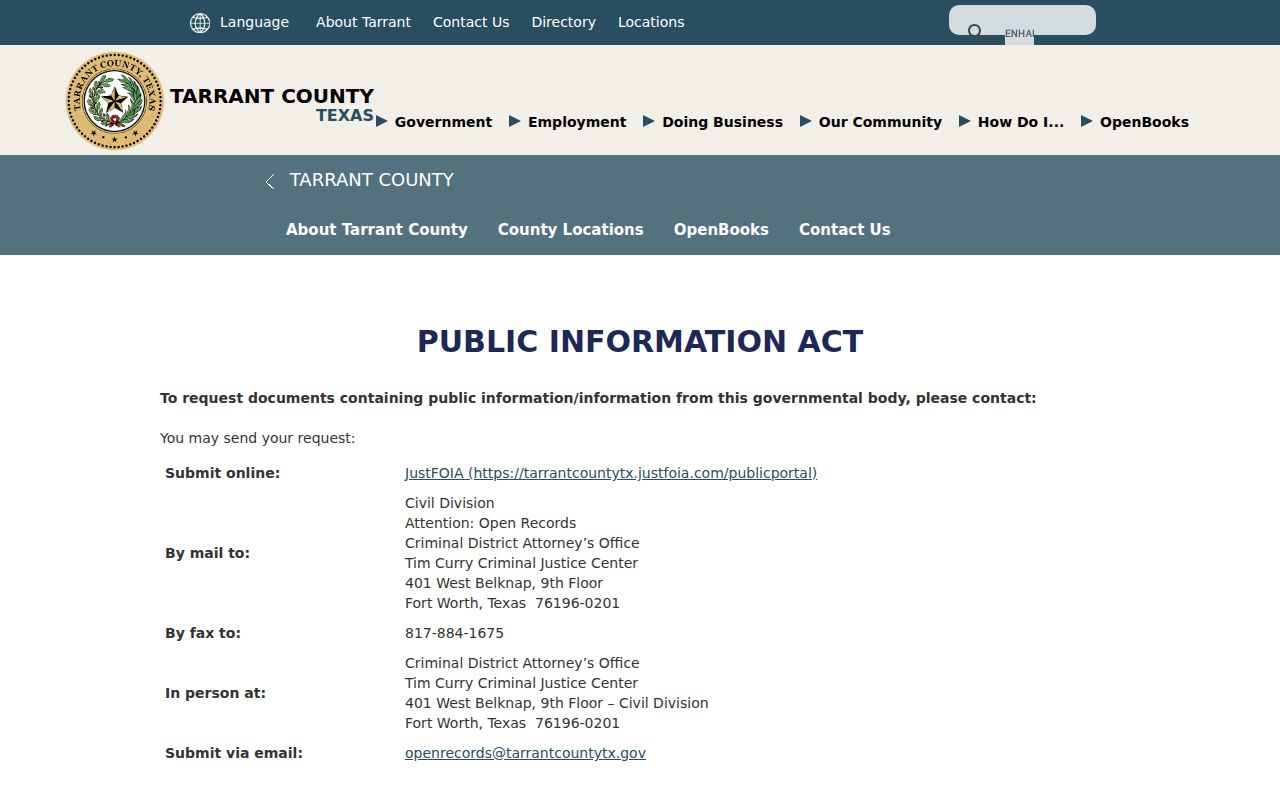
That distinction helps Fort Worth requesters follow a pending record without treating silence as a final result.
Fort Worth Arrests and Bookings
A Fort Worth arrest creates more than one record. Police create the arrest or offense report. A detention agency creates booking data, fingerprints, charge and bond entries. A magistrate creates the first judicial record, and prosecutors may later file a different or narrower charge. DPS can receive the fingerprint event and, later, the disposition. Temporary differences among these sources are normal.
For current county custody, use the Tarrant inmate search. The Daily Booked-In Reports cover a rolling fourteen days, with Day 1 newest. Someone released can disappear from the live roster yet remain in a recent report. Call the central inmate-information line at 817-884-3000 when the web result is unclear. The broader Tarrant County arrest lookup explains these county sources in full.
Note: A booking charge records an allegation at intake, not a finding of guilt or the final filed charge.
Fort Worth City and County Cases
“Fort Worth court record” can describe three very different files. Municipal Court handles city ordinances and Class C or other fine-only matters. Tarrant County Criminal Courts handle Class A and B misdemeanors. Tarrant criminal district courts hear felonies. The keeper changes with that jurisdiction, not with the requester’s address.
| Record | Keeper | Typical scope |
|---|---|---|
| City citation or ordinance case | Fort Worth Municipal Court | Fine-only and city matters |
| Class A or B misdemeanor | Tarrant County Clerk | County Criminal Courts 1 through 10 |
| Felony prosecution | Tarrant District Clerk | Criminal district courts |
Do not use re:SearchTX as a substitute. The statewide service excludes criminal case records. Remote District Clerk web access requires a subscription, while public terminals are the no-subscription alternative.
Municipal Court Records in Fort Worth
Fort Worth Municipal Court keeps its own city files and offers a Court Records Request Form through its official service page. A city docket can identify the citation, charge, settings, plea, judgment, payment status, and warrant or compliance events that belong to that fine-only case. It will not contain a county misdemeanor or district felony merely because the event occurred in Fort Worth.
The Fort Worth Municipal Court page is the primary source for its current records route and court services.
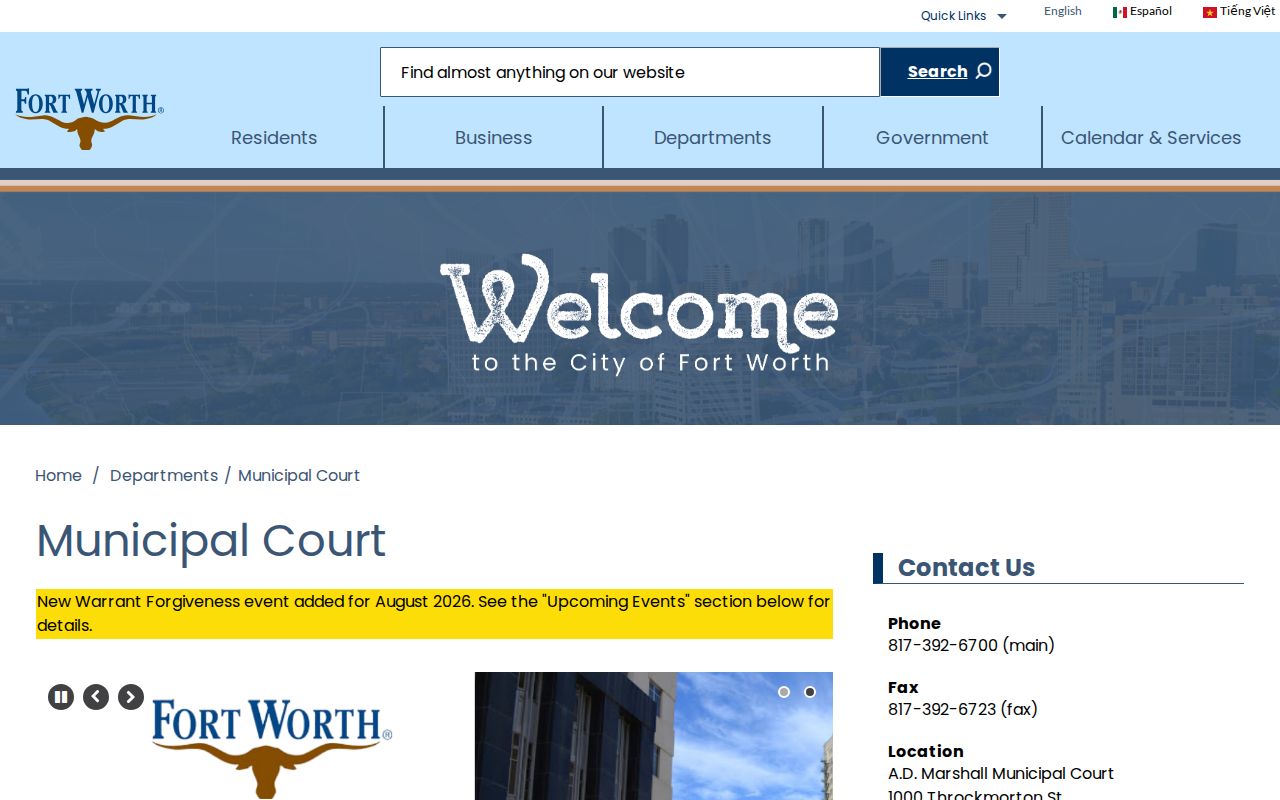
This court channel keeps city citation records separate from the county clerk system downtown.
| Court Name | Fort Worth Municipal Court |
|---|---|
| Case Types Heard | City ordinances and Class C or other fine-only matters |
| Case Lookup Channel | Official court service page and Court Records Request Form |
| What the Docket Shows | Citation, settings, plea, judgment, payment, and court status |
| Copies & Fees | Use the live court request route for the current schedule |
Fort Worth Criminal Records Hub
Fort Worth is both a city and Tarrant County’s seat. That makes downtown a records hub, but it does not merge custodians. The historic 1895 courthouse is a pink-granite landmark. Criminal clerk service is centered instead at the Tim Curry Criminal Justice Center, 401 W. Belknap. Police headquarters is a separate city site on Felix Street. The City Secretary’s request address is another location.
This geography trips up people who equate “courthouse” with every criminal record. Ask which office made the item. A police narrative stays with the city. A county judgment stays with the proper clerk. A booking file stays with the Sheriff. The District Clerk criminal desk can be reached at 817-884-1342 or 817-884-1343; the County Clerk Criminal Division uses 817-884-1066.
Where Fort Worth Records Go
A city arrest can move through several record systems. Fort Worth officers author the initial agency report. A county booking adds custody data. Prosecutors decide what to file, and the correct clerk records the case. The court then reports qualifying dispositions to DPS. A city fine-only case remains in Municipal Court rather than moving into a county criminal court.
Record flow: Fort Worth Police Department › Tarrant County Courts › Texas Department of Public Safety
For a recent event, read the Fort Worth report and current booking source first. For an older prosecuted matter, use the latest clerk disposition. For one’s own identity-matched statewide history, follow the DPS fingerprint review process. Each layer answers a different question.
Specific Fort Worth Record Requests
Tarrant County warns that government generally cannot create an all-time criminal-history compilation for a named person. The practical route is to identify a specific case, arrest, or incident at the proper city or clerk source, then request the underlying document. A cause number, report number, filing date, and court narrow the search and reduce false matches.
The county record-routing explanation shows which office holds common document types.
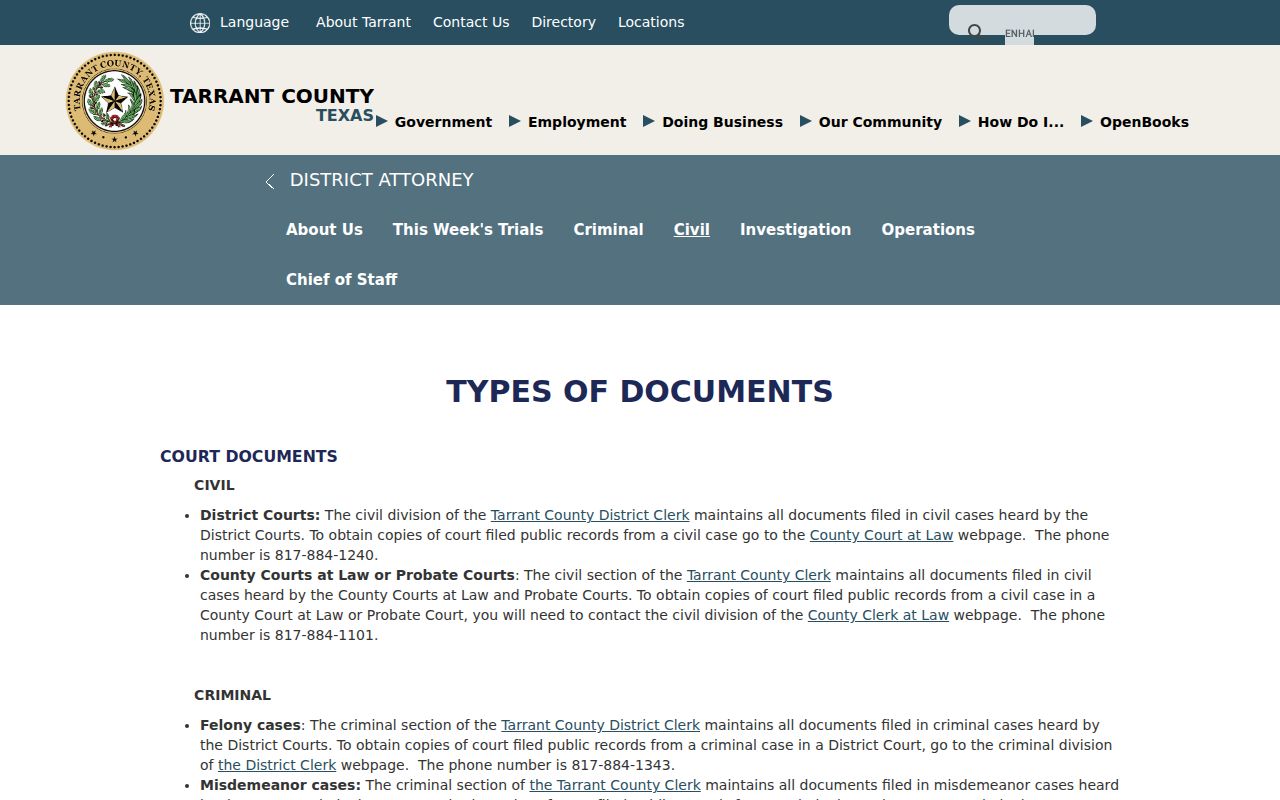
The routing page reinforces why a request for one named Fort Worth document works better than a broad name compilation.
Correcting Fort Worth Criminal Records
A mismatch should go back to the office that owns the disputed field. Fort Worth Police can address an agency report, but it cannot rewrite a clerk judgment. The Tarrant County jail can address a booking field, while the County Clerk or District Clerk controls the court disposition in its file. DPS has its own correction process for repository history. Sending the same broad request to every office may produce conflicting replies.
Save the report, booking reference, cause number, and exact field believed to be wrong. Obtain a certified judgment or disposition from the correct clerk when the court outcome is the issue. Compare that certified record with one’s own fingerprint-based DPS review. Then use the repository correction route if the Texas history has a missing or stale outcome. An accurate police report can remain even when the charge was later dismissed, so the goal is accurate linkage rather than deletion by assumption.
Expunction under Chapter 55A or an order of nondisclosure under Chapter 411 is a court remedy with separate eligibility rules. A dismissal does not automatically erase every Fort Worth booking or police record. When a court grants relief, keep certified copies and verify that each named agency has processed the order.
Public Access Rules in Fort Worth
Texas law starts with public access but protects defined information. Pending investigative material, juvenile records, victim identifiers, private personal data, expunged records, and criminal history covered by an order of nondisclosure may be withheld. Court files are also subject to sealing and confidentiality rules. Ordinary access does not turn a record into a complete account of guilt or identity.
Key Statutes:
Texas Public Information Act presumes government information open while protecting specified law-enforcement and nondisclosed material.
Texas Government Code Chapter 411 controls dissemination of DPS criminal history and orders of nondisclosure.
Code of Criminal Procedure Chapter 55A governs eligibility and process for expunction.
A requester should compare the latest disposition with the original charge and verify consequential details with the office that holds the source file.