
Tarrant County Criminal Court Cases
Tarrant County divides criminal court files by the level of the alleged offense. The criminal district courts hear felonies, and the Tarrant County District Clerk keeps those files. Ten County Criminal Courts hear Class A and Class B misdemeanors, with the Tarrant County Clerk as custodian. Municipal courts keep fine-only state-law and ordinance cases filed in their cities. Justice Courts in Precincts 1 through 8 also hold the limited criminal and traffic matters assigned to them. The name of the arresting agency does not decide which clerk has the later case. The filed offense and the court named on the notice do.
The Tarrant County District Clerk describes felony services and public record access. It also directs readers to web access, copy services, and criminal division contacts. The official page is shown below.

That clerk is the first stop for a district felony cause number, docket, judgment, or certified copy. Class A or B misdemeanor questions instead go to the County Clerk Criminal Division.
Pick the Tarrant County Case Clerk
A quick jurisdiction check prevents many empty searches. A felony indictment belongs with the District Clerk. An information charging a Class A or B misdemeanor belongs with the County Clerk. A fine-only citation stays with the issuing municipal or justice court. Staff at one clerk cannot supply the other clerk's records or give legal advice. The County Clerk can, however, provide the misdemeanor case number, assigned court, court date, attorney, and bondsman when those details are public.
District Clerk Criminal Division
Tim Curry Criminal Justice Center
401 W. Belknap
Fort Worth, TX 76196
817-884-1342 or 817-884-1343
County Clerk Criminal Division
Tim Curry Criminal Justice Center, second floor
401 W. Belknap
Fort Worth, TX 76196
817-884-1066
Municipal cases require the named city court, while a Justice Court matter requires the precinct shown on the citation. The county criminal record does not merge those dockets into one public search.
Searching Tarrant County Case Records
Use the most exact identifier available. A cause number is better than a common name, and a filing range can separate people who share a name. Remote felony access is available through a subscription service, while courthouse public terminals provide an alternative. Older or unscanned items and certified records must be requested from the clerk that owns the file. The County Clerk offers a $5 Class A/B misdemeanor name search, with records dating to 1976.
- Decide whether the filed matter is a felony, Class A/B misdemeanor, or a fine-only city or Justice Court case.
- Use the exact cause number when known. Otherwise, search the defendant name and narrow it by court or filing range.
- Compare the assigned court and charge details. Never assume a name match identifies the same person.
- Open the docket and read the newest disposition, judgment, or setting rather than relying on the first charge.
- Ask the proper clerk for a certified judgment or disposition when an official copy is needed.
| Field Label | Type | Required | Notes |
|---|---|---|---|
| Case/Cause Number | Text | Optional | Best exact lookup; keep punctuation shown on the notice |
| Party/Defendant Name | Text | Optional | Try spelling variants or aliases separately |
| Court | Filter | Optional | Separates district felony from county misdemeanor data |
| Filing/Date Range | Date | Optional | Helps narrow common names |
| Case Type/Status | Filter | Optional | Choices depend on the clerk product |
Tarrant County Felony Web Access
District Clerk Web Based Access includes district felony databases and imaged documents for subscribers. The county advertises access for 23 hours each day, seven days a week, which leaves a maintenance window. Its history reaches back to the Dial-In service, whose criminal access began in March 1996. That date describes the remote service, not a claim that earlier court files do not exist.
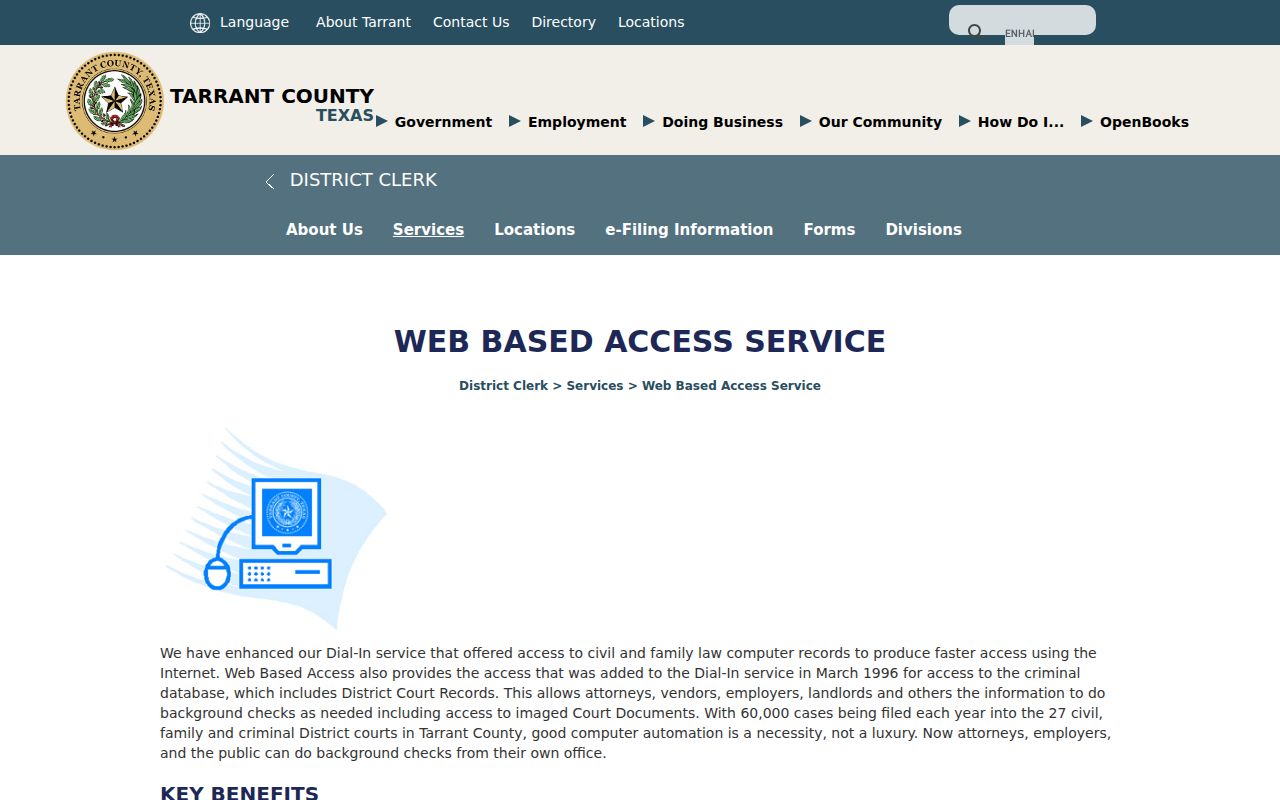
The captured service page helps distinguish remote subscriber access from the free public terminal option. It also explains why a document may require a clerk copy even when a docket entry appears online.
The County Clerk follows a different route. Its criminal court records information covers Class A/B misdemeanors, the $5 name search, available details, and copy requests.
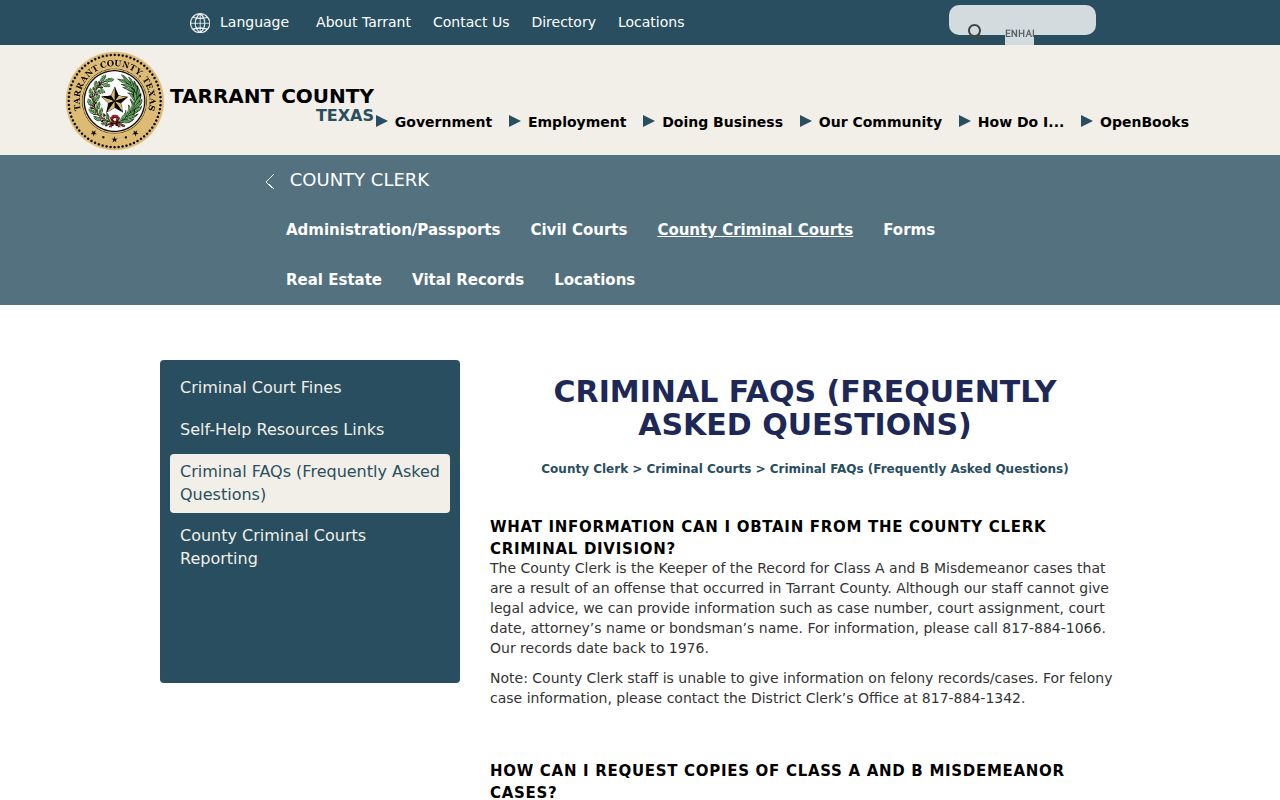
This county page is the correct starting point for misdemeanor record questions, not the District Clerk's felony database. The split matters when a name appears in one system but not the other.
Inside a Tarrant County Case File
A Tarrant County criminal case file tracks what prosecutors filed and what the court did afterward. It can show a complaint, indictment or information, bond papers, attorney appearances, motions, hearing settings, pleas, judgment, sentence, and later enforcement events. The latest entry matters. An initial accusation is not a final outcome, and the filed charge may differ from the offense listed at booking.
| Cause Number and Court | The unique case reference and the court assigned to hear it. |
|---|---|
| Charging Document | The complaint, indictment, or information stating the filed charge and its class or degree. |
| Docket Entries | A dated register of filings, appearances, motions, settings, pleas, and orders. |
| Bond and Counsel | Public bond entries plus attorney and bondsman details where recorded. |
| Disposition and Judgment | The recorded outcome, such as dismissal, acquittal, deferred adjudication, or conviction. |
| Sentence and Costs | Punishment, community supervision, fines, court costs, and balance entries when applicable. |
Public views normally redact Social Security numbers, full birth dates, protected addresses, victim and minor identifiers, and other confidential data. Some document images are limited to subscribers or supplied as paid copies.
Read Tarrant County Case Outcomes
Short docket terms can change the meaning of a Tarrant County result. Read the status for each charge, not just the case caption. A dismissal ends a charge without conviction but does not itself erase the arrest. Deferred adjudication places a person on community supervision without an immediate finding of guilt. An acquittal is a not-guilty result. A conviction is a judgment of guilt. A no-bill means the grand jury declined to return an indictment.
- Arraignment
- The event where the accused is formally called on to enter a plea.
- Disposition
- The final or current outcome recorded for a charge.
- Nolle prosequi
- The prosecutor's formal choice not to continue a charge; it is not a conviction.
- Capias
- A court order directing custody, sometimes issued after a failure to appear or comply.
- Mandate
- The formal direction that follows an appellate court's decision.
When the words are unclear, obtain the judgment or disposition from the clerk instead of inferring an outcome from a setting or bond entry.
How a Criminal Case Moves
Once a prosecutor files a Tarrant County charge, the court record develops in stages. The charging paper defines the court case, even when it differs from the booking charge. Arraignment places the plea on the record. Pretrial work can include counsel appearances, discovery, motions, bond review, and hearing settings. The case may then resolve by plea, dismissal, or trial. A judgment records the disposition, and sentencing states the punishment or community supervision terms after a conviction.
Case flow: Charges Filed › Arraignment › Pretrial › Plea or Trial › Disposition › Sentencing
A later motion to revoke or adjudicate can add new docket events. Read beyond the first judgment when community supervision or an appeal may have changed the posture.
Missing Tarrant County Court Records
An empty online result does not prove that no Tarrant County case exists. The search may be in the wrong clerk system, the spelling may differ, a recent filing may not yet appear, or an older document may not be scanned. Start by confirming the offense level and issuing court. Then call the keeper with the cause number, defendant spelling, and an approximate filing date. If no cause number is known, use the clerk's public terminal or name-search service.
The County Clerk locations page identifies the Tim Curry Criminal Justice Center counter and its current office details.
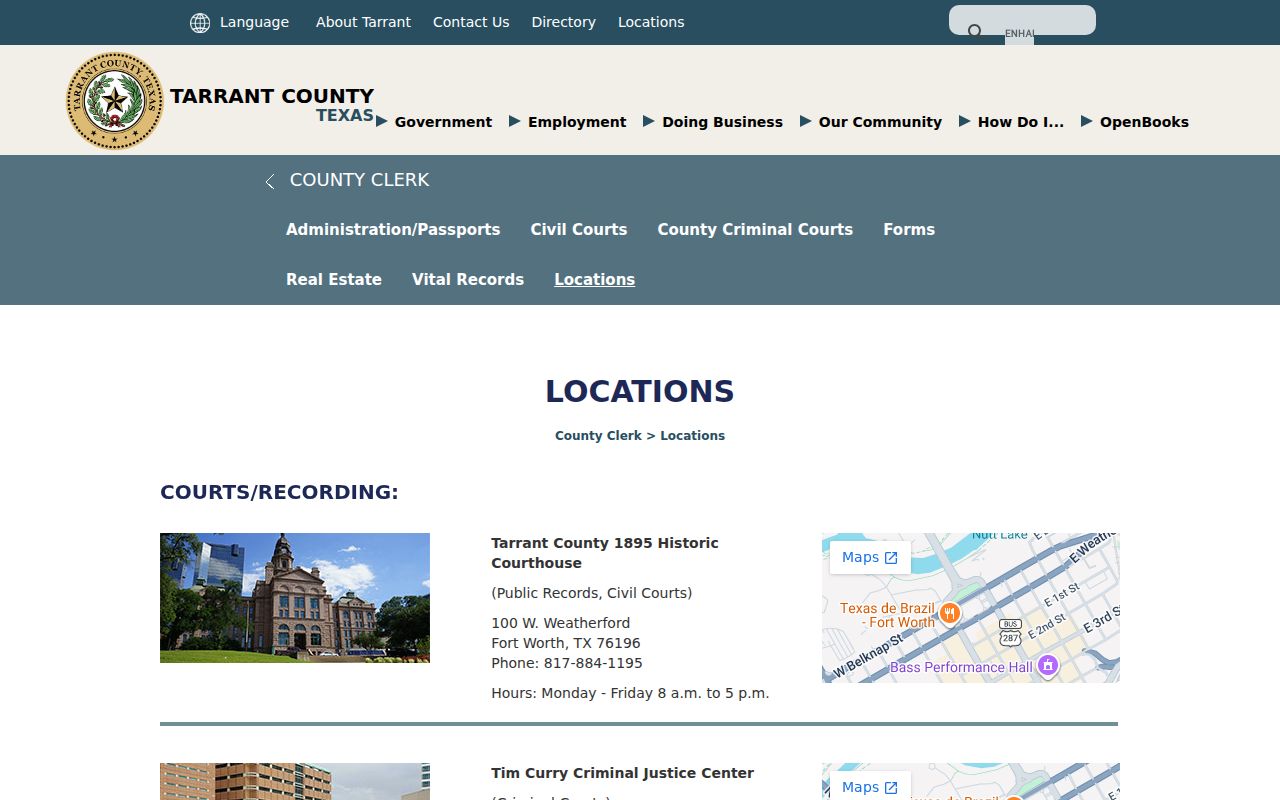
That counter can route misdemeanor copy requests. Felony archive and certified-copy requests remain with the District Clerk Criminal Division.
Note: A screen result is useful for research, but a certified clerk copy is the stronger record of a filed outcome.
Case Record Access & Restrictions
Texas court records are generally open, but access is not absolute. The Texas Public Information Act governs agency records and protects specified law-enforcement material. Court access also operates through judicial rules and clerk procedures. Juvenile files, victim and minor identifiers, protected personal data, expunged records, nondisclosed criminal history, and sealed material may be absent or redacted. Pending investigative records can also be withheld under an applicable exception.
The statewide re:SearchTX service does not solve this gap. Official Judicial Council material says criminal case records are excluded. Tarrant County felony and misdemeanor searches therefore stay with the local clerks. An order of nondisclosure limits public disclosure, while an expunction under Chapter 55A can require qualifying records to be removed under its terms.
Federal Criminal Cases in Tarrant County
Federal criminal dockets are a separate layer. Tarrant County lies in the Fort Worth Division of the U.S. District Court for the Northern District of Texas. County clerks do not keep those files. The Northern District of Texas supplies court and clerk information for the federal courthouse.
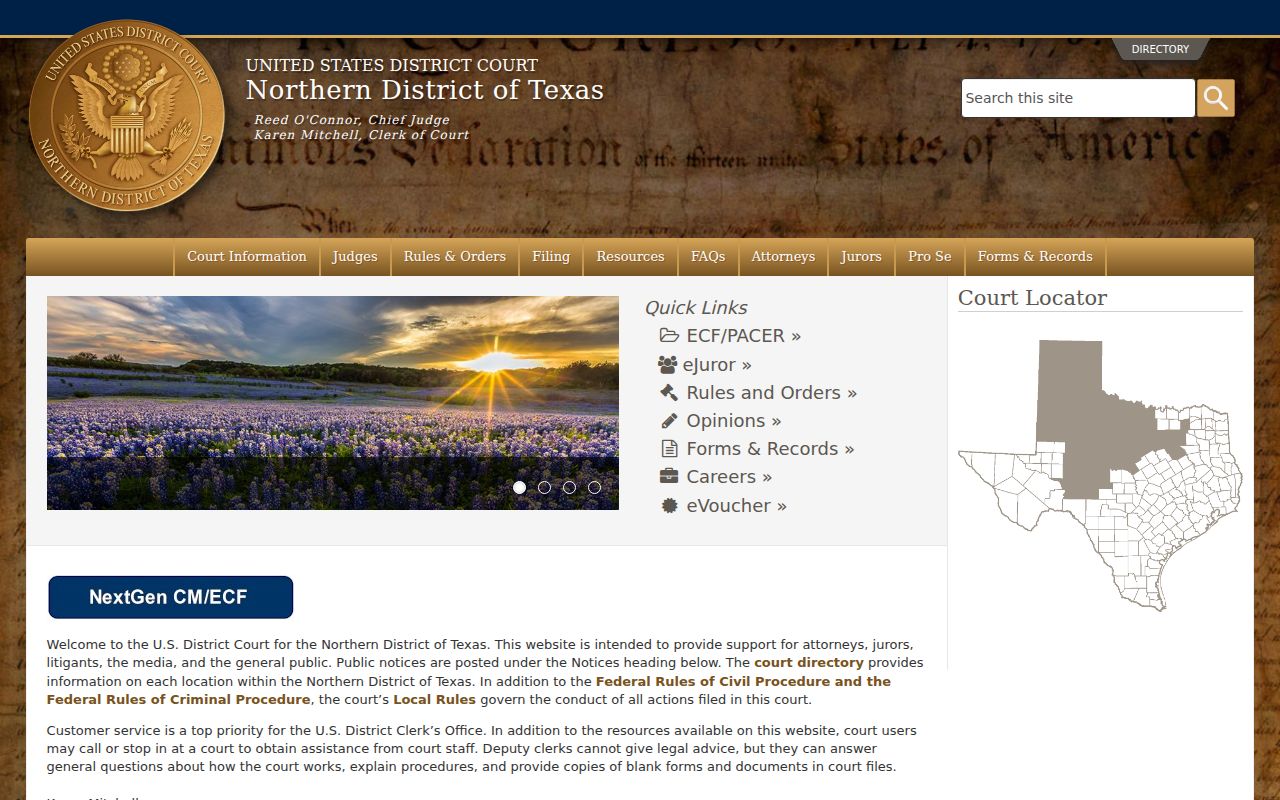
The district court page establishes the correct federal jurisdiction, but docket searches run through PACER.
PACER requires an account and publishes its current per-page fee and low-usage waiver. Search by federal case number or party name, then confirm the assigned court and latest docket entry.
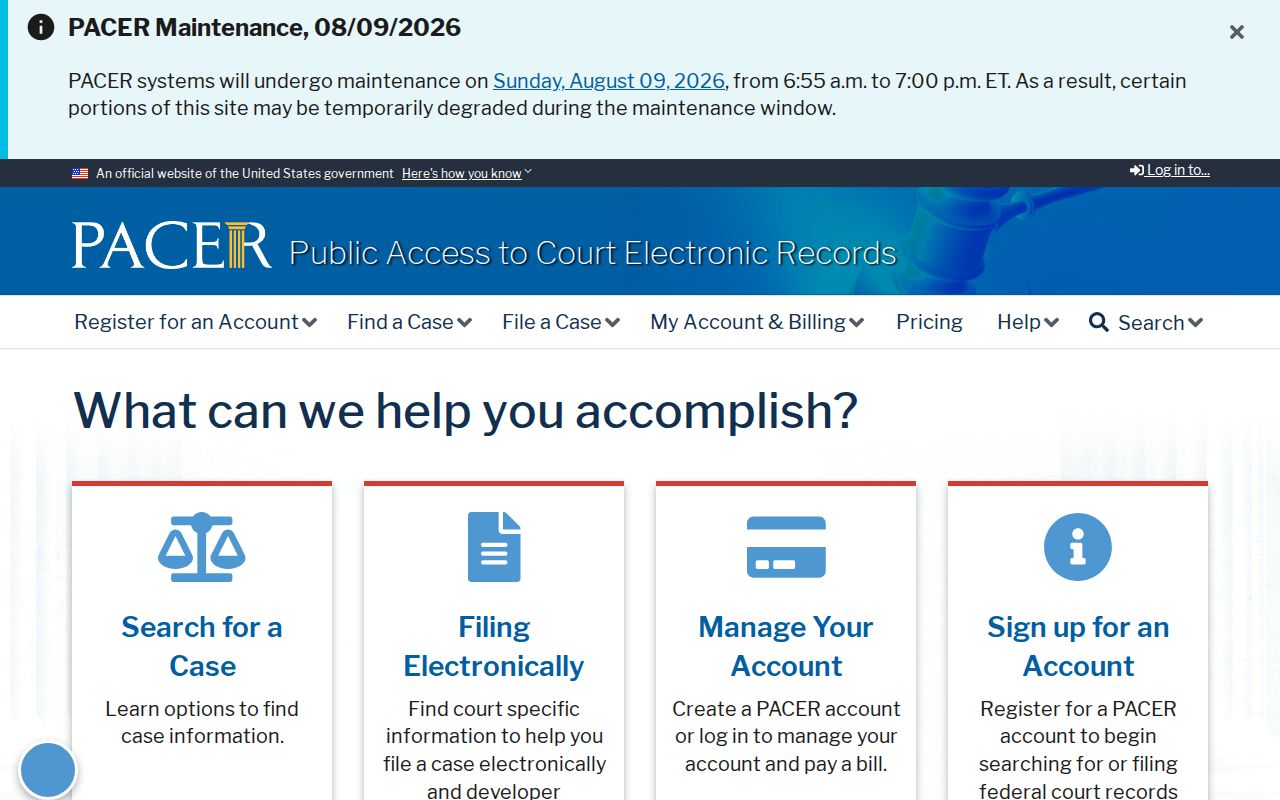
This federal search does not replace the Tarrant County District Clerk or County Clerk. It covers a different court system and a different case file.