
Tarrant County Arrest History
A single Tarrant County arrest creates more than one record. The officer's agency writes the incident or arrest report. The jail creates intake data, fingerprints, a photograph, charge and bond entries, and a custody status. A magistrate records warnings, probable cause, and bond action. If prosecutors accept a charge, the District Clerk or County Clerk opens a court file. Texas DPS may later connect the fingerprint arrest event with a court disposition in its Computerized Criminal History system.
The Tarrant County Sheriff's Records Division explains access to local jail records and restricted incarceration-history letters.
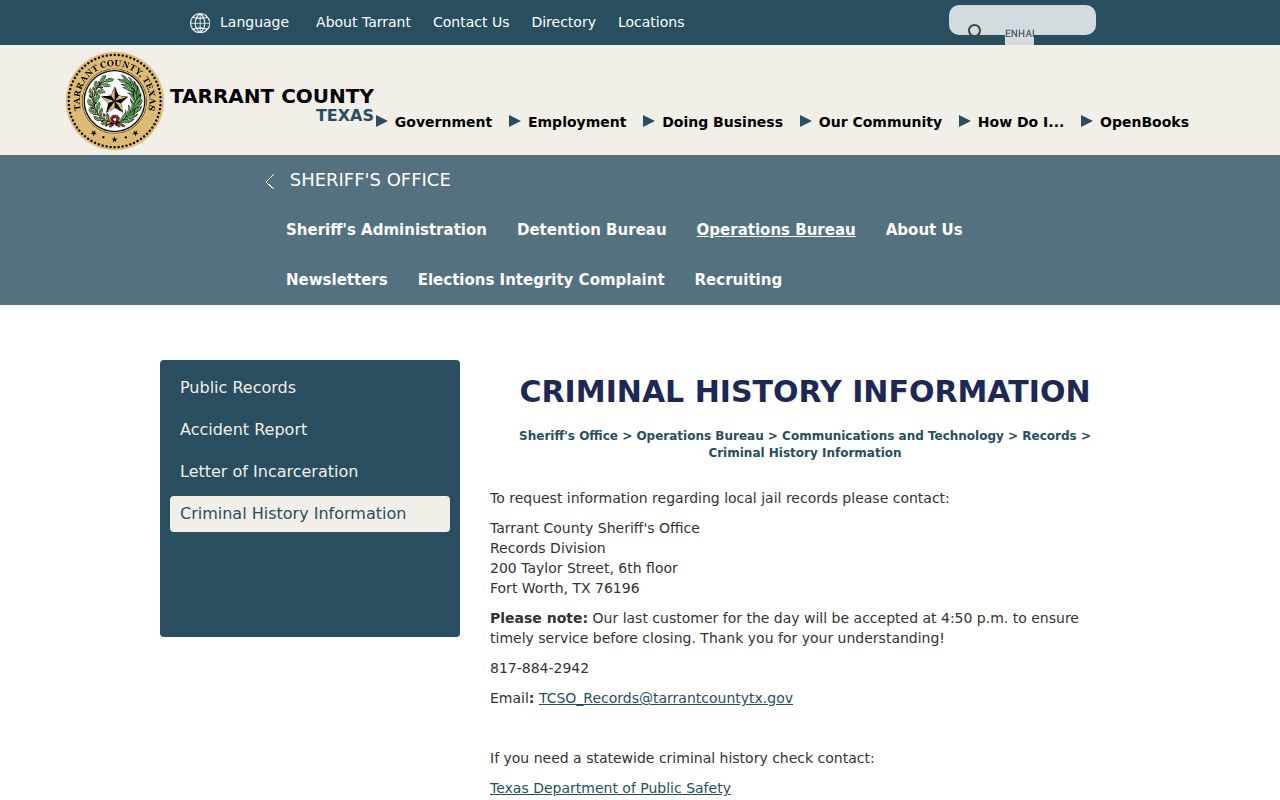
This office holds county jail material, but it may not hold a city police narrative. The agency that wrote the report remains the best source for that document.
Four Tarrant County Arrest Records
The records created during a Tarrant County arrest answer four separate questions. The police report explains what officers alleged happened. The booking file shows intake and custody. The court file shows what prosecutors filed and how the court resolved it. The DPS cycle shows reportable statewide arrest and disposition data associated with an identity. Charges can change between those steps, and a lag in one system does not prove another system is wrong.
Record flow: Arresting Agency › Jail Booking › Magistrate › Prosecutor and Clerk › Texas DPS
Use the incident number with the arresting agency, the booking or CID number with the jail, and the cause number with the clerk. For review of one's own identity-matched Texas history, follow the DPS fingerprint procedure through FAST and IdentoGO. A paid public DPS name search is not the same as a subject-authorized fingerprint review.
Looking Up Tarrant County Arrests
A complete Tarrant County arrest lookup uses every relevant official channel. Begin with the live jail search for present custody and the rolling reports for recent intake. If the web record is unclear, call the jail. Then identify the arresting agency before asking for the narrative report. Once charges are filed, move to the proper court clerk. Older incarceration compilations have stricter access rules than a specific booking record.
- Search the official current inmate database with the exact legal surname, then add a first name or booking identifier.
- Review each relevant Daily Booked-In Report within its fourteen-day window.
- Record the booking or CID number, arresting agency, charge, bond, and case or warrant reference.
- Call the jail information line at 817-884-3000 when location, bond, or custody status is unclear.
- Request the offense report from the arresting agency with an incident number, date, location, and named document.
- Check the District Clerk for a filed felony or the County Clerk for a Class A/B misdemeanor, allowing for filing lag.
- Use DPS for qualifying statewide public history, or the DPS fingerprint channel to review one's own identity-matched record.
The Sheriff's inmate search gateway directs readers to the live county custody tool.
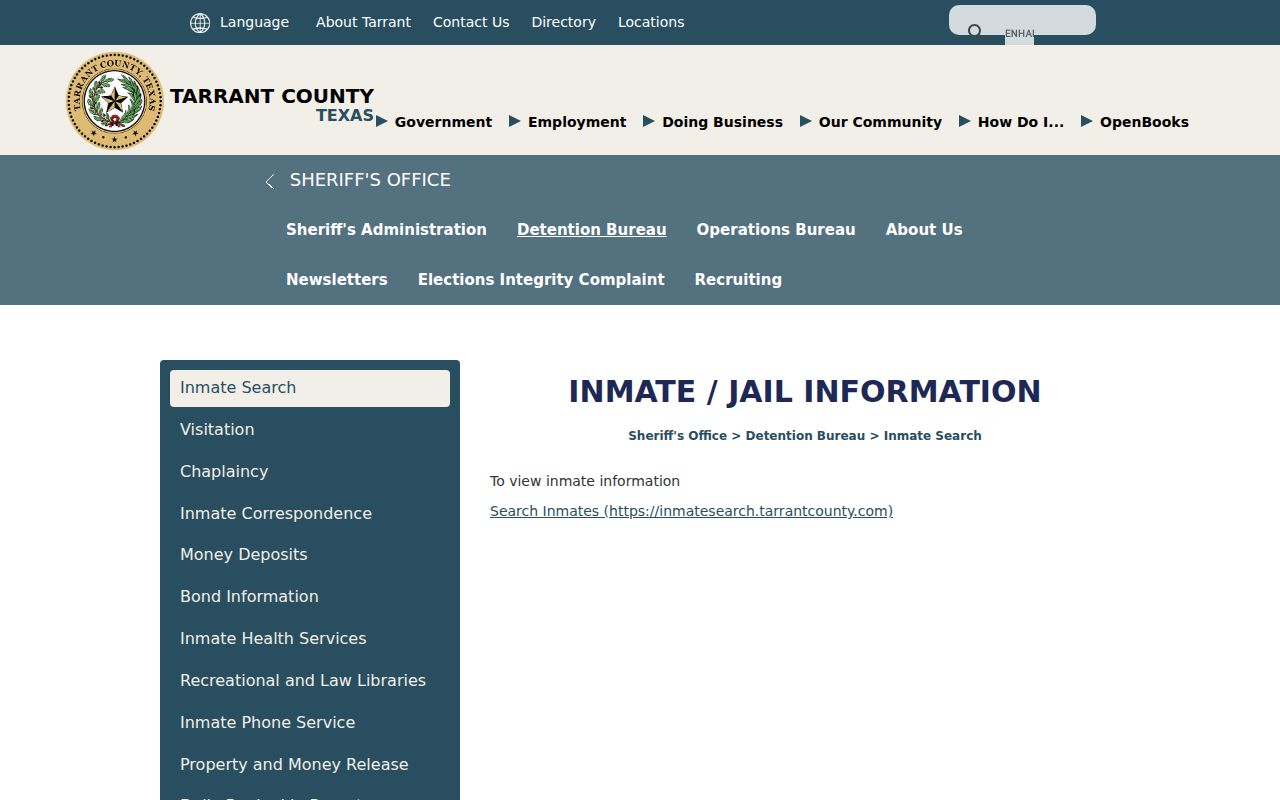
The gateway also provides county context for the roster. It should be paired with the recent booking reports when timing matters.
Current Tarrant County Arrest Custody
The live Tarrant County inmate search answers whether a person appears in current county custody. Search by surname, add the first name to narrow the result, and use a booking or CID identifier when available.
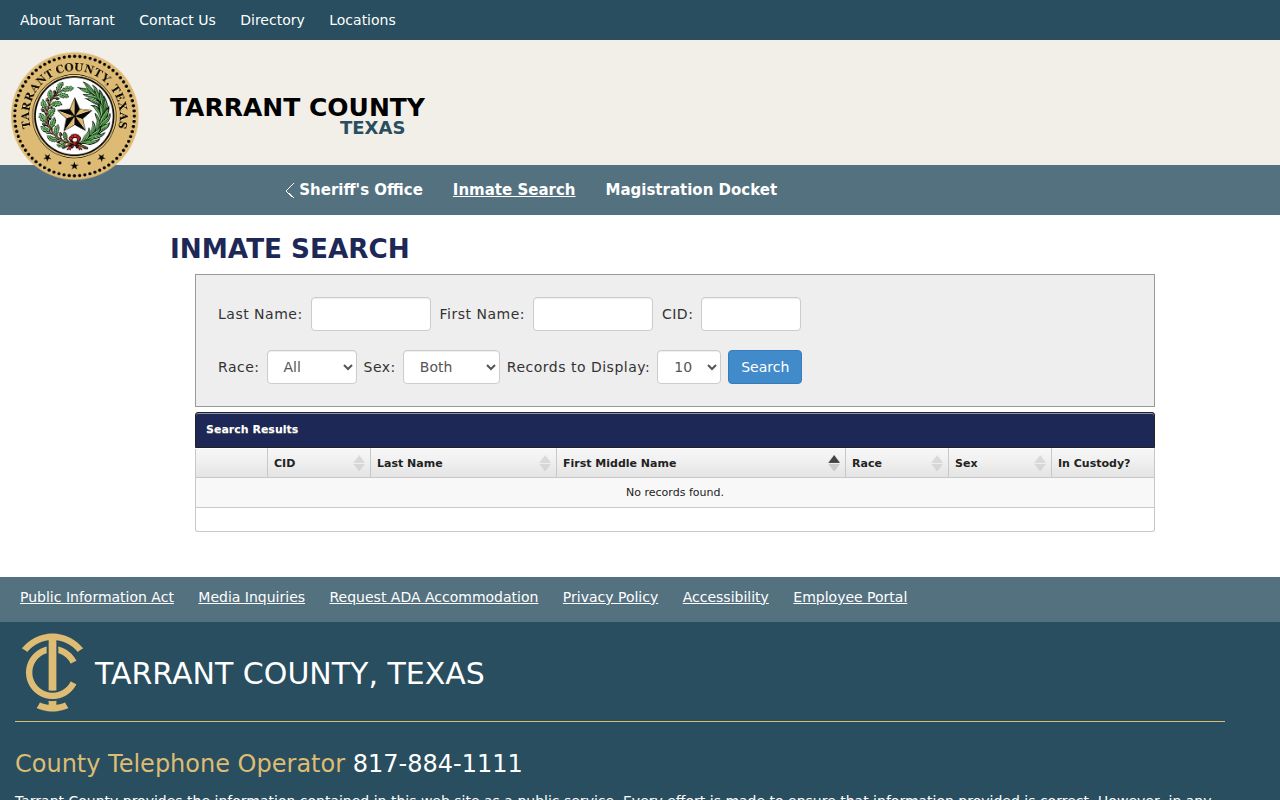
The live interface is the best official check for present Tarrant County custody, but an empty result has several possible causes and calls for a second channel.
A person may have been released, transferred, booked under a different spelling, held in another county, or moved to state or federal custody. Call 817-884-3000 for unclear county custody. Use the TDCJ Online Inmate Search for a person serving a state prison sentence and the federal Bureau of Prisons locator for federal custody. Texas VINE can supply custody-status notifications through its official channel.
Note: A missing current-custody result does not establish that no Tarrant County arrest occurred.
Inside a Tarrant County Arrest Record
Tarrant County arrest records can hold identifiers, allegations, booking data, and custody actions. The narrative report may include probable cause, evidence, and the transport destination. The jail entry focuses on intake, the charge received at booking, facility, bond, and release or transfer. A later court record adds the prosecutor's filed charge and the case result. Protected medical, classification, juvenile, victim, and personal identifier data should not be expected in a public record.
| Incident or Arrest Number | The arresting agency's reference for its report and related materials. |
|---|---|
| Arrest Details | Date, time, place, arresting agency, officer, and the alleged offense. |
| Booking Identifier | The county CID or booking number used to distinguish the jail entry. |
| Custody and Facility | Intake time, current location, and release or transfer status. |
| Charge and Bond | The intake charge, related case or warrant reference, and bond amount or type. |
| Court Follow-Through | The filed charge, cause number, court settings, and final disposition when a case follows. |
| DPS Cycle | SID and tracking data connecting a reported arrest to a later prosecutor or court outcome. |
Do not treat a booking photograph as evidence of guilt. No arrestee names or booking images are republished here; the official systems should be used with care and the court outcome checked.
Route Tarrant County Arrest Reports
The jail is not always the keeper of the offense narrative. Ask the agency whose officer made the Tarrant County arrest. Fort Worth and Arlington use city public-information channels. Grand Prairie Police expressly accepts requests for arrest records, case files, offense or incident reports, accident reports, and certain video. Constable, campus, school, transit, and DPS records go to their own custodians. A county request may produce no city-authored report when no county prosecution generated a county-held copy.
| Agency | Records Route | Core Contact |
|---|---|---|
| Tarrant County Sheriff | TCSO Records or county JustFOIA | 200 Taylor, sixth floor; 817-884-2942 |
| Fort Worth Police | City open-records or police report channel | 505 W. Felix St.; 817-392-4222 |
| Arlington Police | City police records or open records | 620 W. Division St.; 817-274-4444 |
| Grand Prairie Police | Police Open Records Request | 1525 Arkansas Lane; 972-237-8790 |
| Constable or Other Agency | The issuing precinct or agency custodian | Use the incident reference and official directory |
Target the request to a named incident or arrest. Tarrant County generally cannot compile every encounter connected to a person, and an active investigation or prosecution may support withholding under the Texas Public Information Act.
Booking Logs and Recent Arrests
TCSO's Daily Booked-In Reports provide the best official date-based view of recent Tarrant County arrests. Fourteen links form a rolling window, with Day 1 as the newest report.
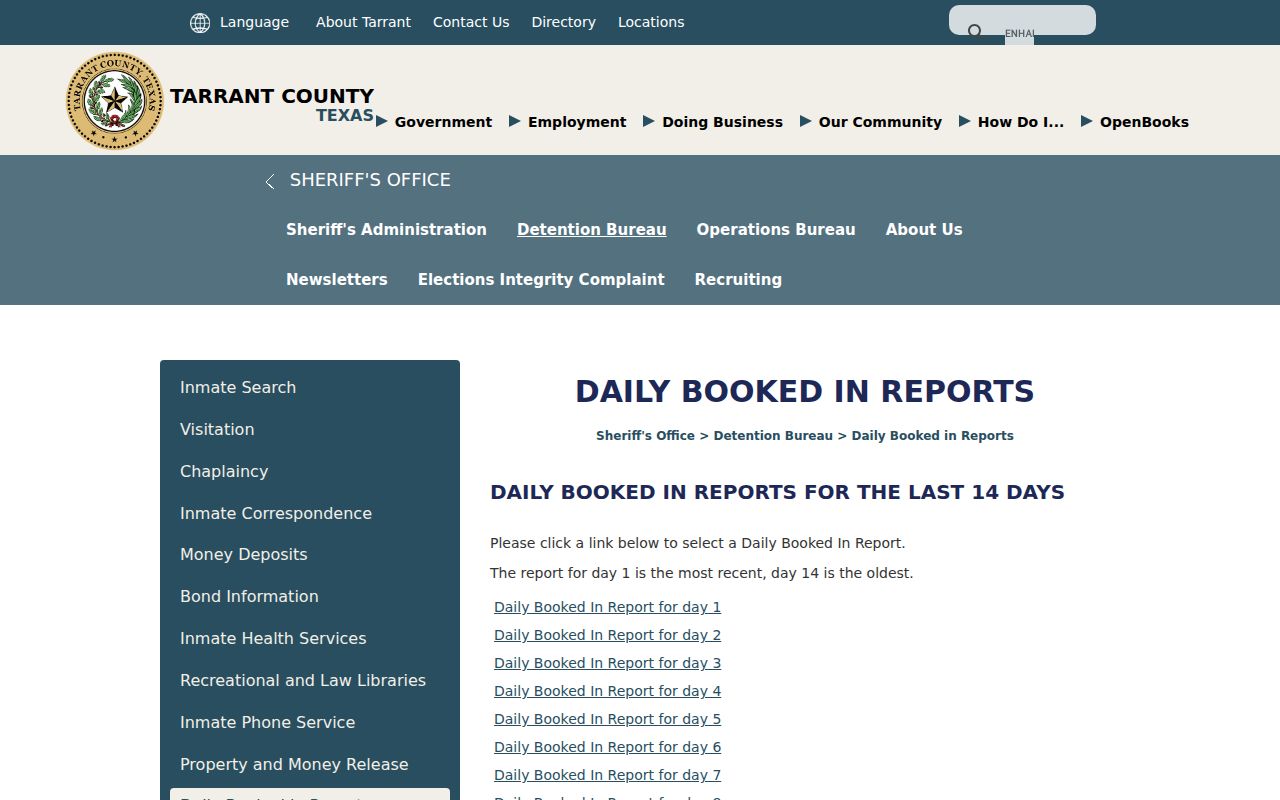
The report menu helps find a booking that has already left the current-custody roster. Save the booking identifier and agency name before the entry rolls outside the window.
The current roster and daily reports answer different questions. Someone released yesterday may remain in a recent report but disappear from the live custody search. Report fields can include name, booking number, intake date, agency, charge, bond, and facility. The charge is still an allegation. A filed charge and disposition must be confirmed with the proper Tarrant County clerk.
Request Tarrant County Arrest Records
The TCSO Records Division is at 200 Taylor Street, sixth floor, Fort Worth, with phone 817-884-2942, fax 817-884-2939, and email TCSO_Records@tarrantcountytx.gov. It handles local jail records and letters of incarceration. A letter that compiles all times a person was in the Tarrant County jail is confidential and may be released only to the subject, the subject's attorney, or a government agency for official use.
TCSO Records Division
200 Taylor Street, sixth floor
Fort Worth, TX 76196
817-884-2942
TCSO_Records@tarrantcountytx.gov
For broader county records, use the Tarrant County JustFOIA portal. A focused request names the agency, incident number, date range, location, specific document, and desired format.
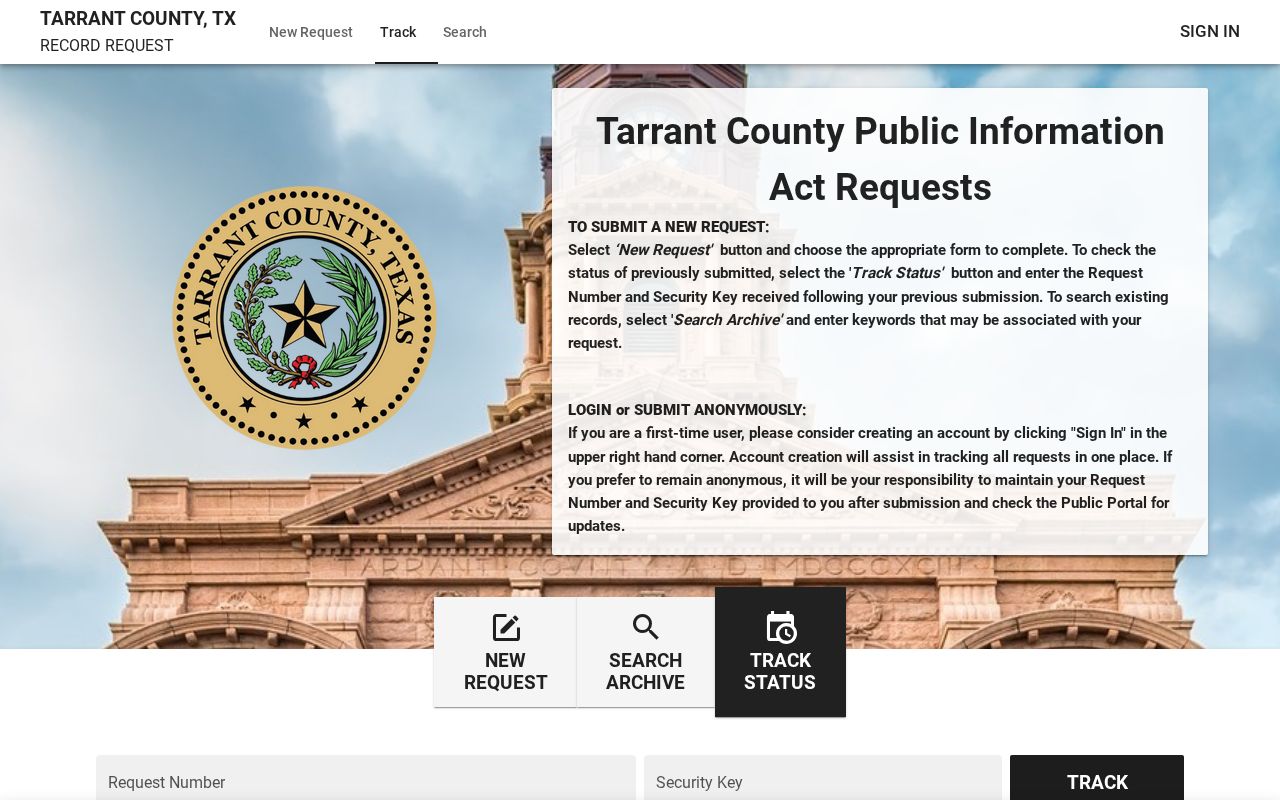
The portal is one route among several. Requests may also go to openrecords@tarrantcountytx.gov, fax 817-884-1675, or the Civil Division, Attention Open Records, at 401 W. Belknap, ninth floor, Fort Worth, TX 76196-0201.
There is no filing fee, though lawful reproduction, labor, media, or programming charges may apply. If an agency seeks to withhold requested material, the ten-business-day rule concerns asking the Attorney General for authority, not a promise that every request will be finished in ten days.
Arrests Are Not Convictions
An arrest shows that an agency took a person into custody or initiated a charge process. It does not show that a judge or jury found guilt. The prosecutor may file a different offense, decline the matter, or dismiss a charge. The court may record deferred adjudication, acquittal, dismissal, conviction, or another result. Read the arrest and court records together before describing what happened.
| Point | Arrest or Booking Record | Conviction Record |
|---|---|---|
| Created by | Arresting agency and jail | Court after adjudication |
| Main meaning | Allegation, intake, and custody event | Judgment of guilt on a filed charge |
| Charge shown | Initial or intake charge | Charge resolved by judgment |
| Best identifier | Incident number or booking/CID | Cause number and court |
| Best source | Agency report and Tarrant County jail data | District Clerk or County Clerk judgment |
Note: A Tarrant County arrest is not proof of guilt; verify the latest court disposition before relying on an alleged charge.
Tarrant County Warrants and Release
A warrant reference may appear on a Tarrant County booking record, but TCSO does not release criminal-warrant information to the general public. Its Criminal Warrants Division supplies that information to licensed bondsmen, attorneys, and law-enforcement agencies. Municipal and traffic warrants must be checked with the issuing court. A deputy citation routes to the Justice of the Peace named on it. Someone resolving their own possible warrant should identify the issuing court and seek case-specific instructions instead of assuming an empty jail search means no warrant exists.
The Sheriff's criminal-warrant policy page states the access limit and lists the correct division contact.
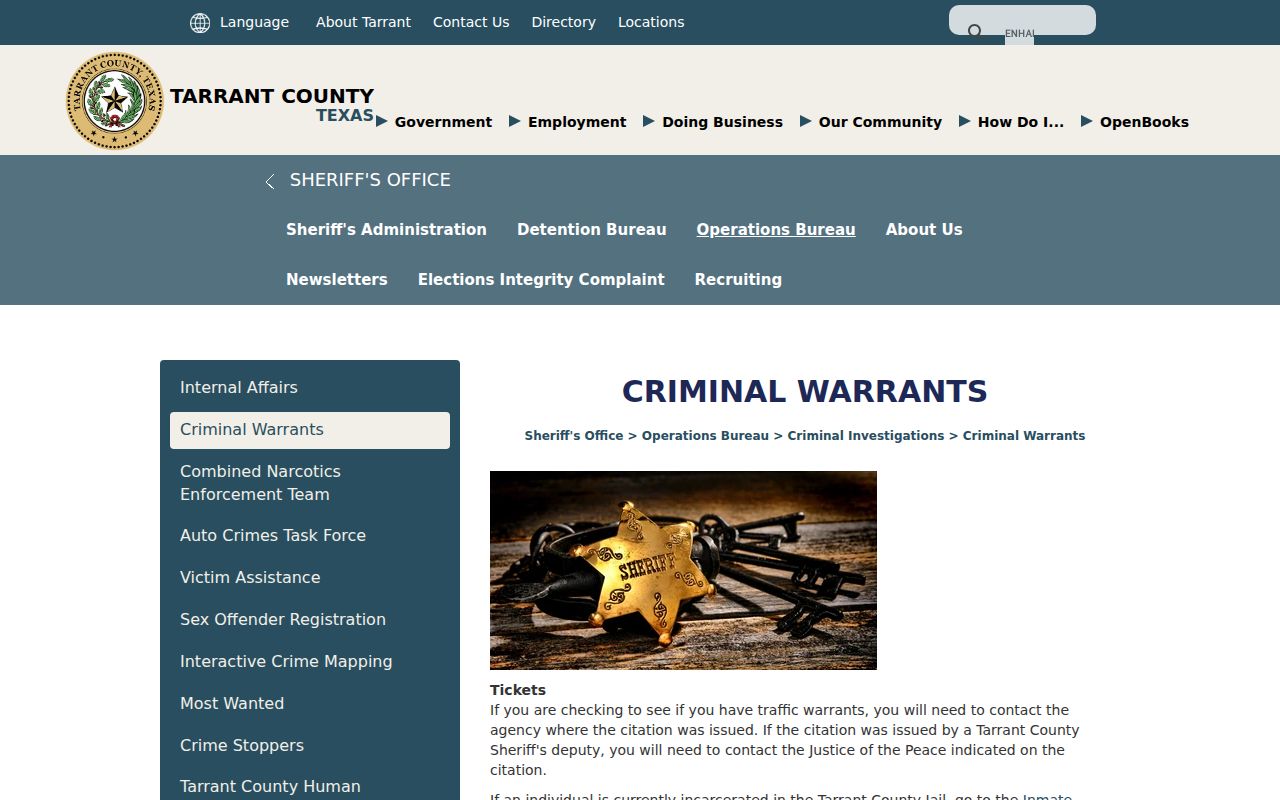
This policy is a vital limit on public arrest research. It also explains why court and counsel channels may be necessary for warrant verification.
After release or transfer, use the recent booking reports for the short local window. Contact TCSO Records for an authorized historical incarceration letter, the TDCJ locator for state prison, or the federal locator for federal custody. A dismissal does not automatically remove a booking. Qualifying records may require an expunction under Texas Code of Criminal Procedure Chapter 55A or an order of nondisclosure under Government Code Chapter 411.